The inspiration for this post came after I recently watched a documentary on Netflix titled “Seaspiracy.” For those that haven’t seen it, I’d highly recommend you to watch it as it’ll give you an idea of the propaganda, lies, and truths about the impact humans have on the ocean. The fisheries industry is a huge conglomerate made up of countries, commercial fishing vessels, manufacturers, and labels within the food industry all perpetuated by governments, large corporations and economies alike. The film goes into detail about some of the corruption involved and depicts how something that one might consider a small issue, actually has a bigger impact than we might know of.
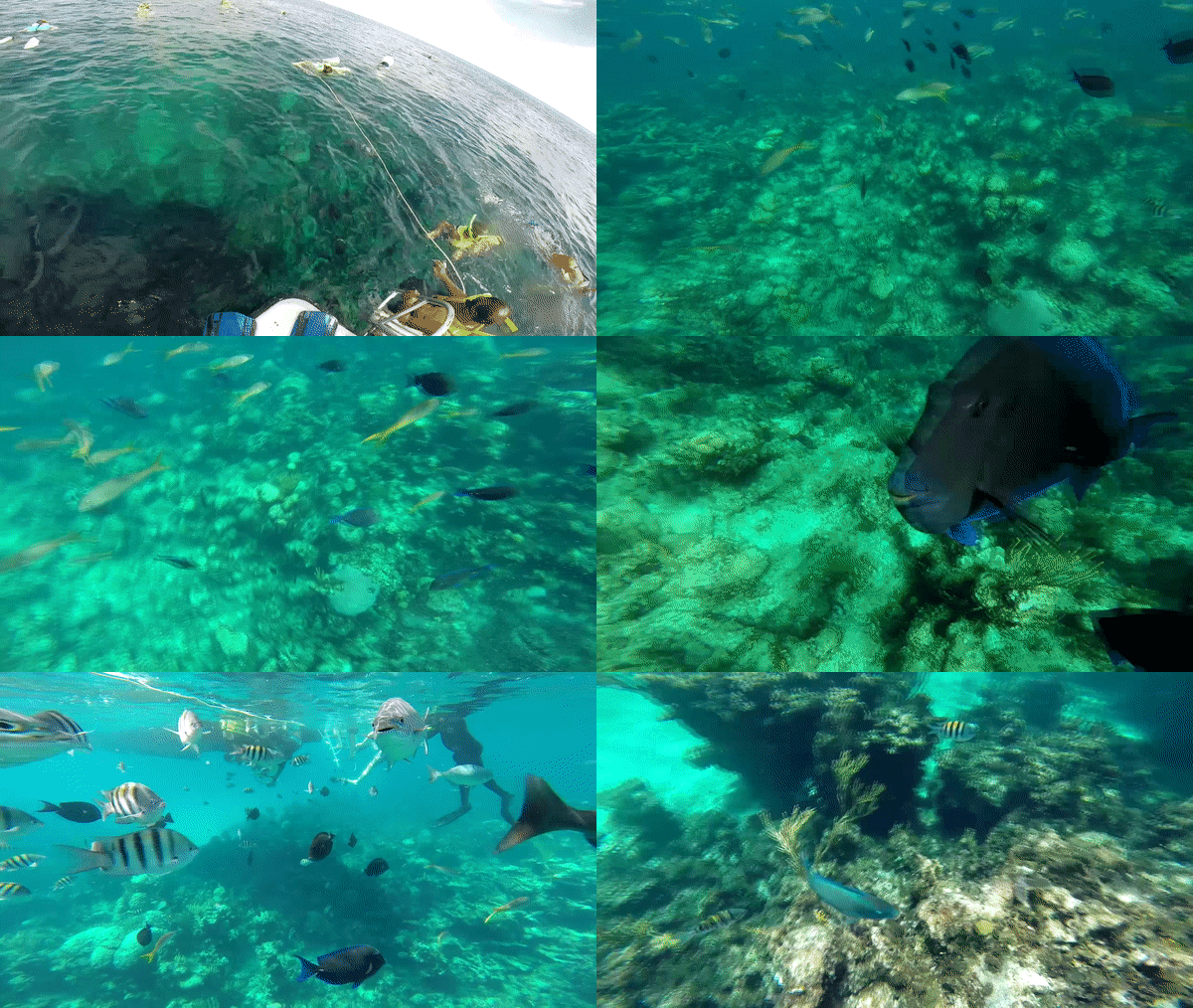
The reason I find this so important is that I love to fish, surf, and swim and I hope to be able to do so in the coming future. Surfing here in New Jersey, I have seen whales breaching and the occasional dolphin pod joining us in the waves. One of my greatest memories was that of snorkeling in a Bahamian coral reef with some of the most colorful species of corals and fish. It is truly a remarkable sight and I encourage anyone who hasn’t experienced this to give it a try before it’s too late.
Introduction
I’ll give you a quick excerpt of a few things mentioned in the documentary to give you a basic understanding of the detrimental effects commercial fishing has across the ocean today.
Understanding The Food Chain
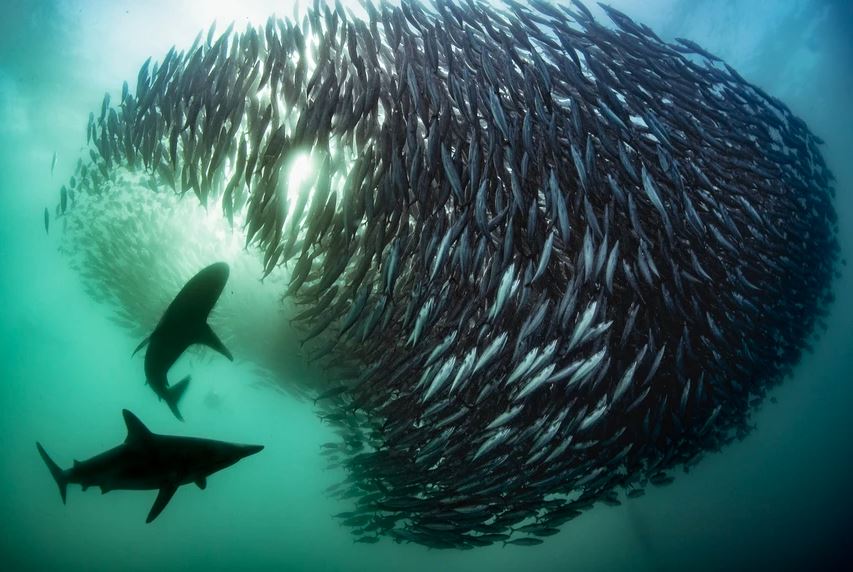
According to the documentary, in order to address climate change, we must first consider the ocean. You can think of it as our life support system which without, everything will begin to perish. 75% of the planet is water and it should be obvious that we depend on this for our species and planetary survival. The ocean depends on its inhabitants to keep it healthy. For instance, sharks being apex predators (Level 1) keep all the other species in check by inhibiting overpopulation of the lesser species who also regulate species lower on the food chain. When you take sharks out of the equation, the species which they feed on (Level 2) will overpopulate and decimate those that are below them (Level 3). These level 2 species will wipe out their own level 3 food supply, and then with no food left, the level 2s will go extinct themselves. This process will carry on to the lowest level down to the smallest of organisms. All of these species overall, provide nutrients that allow coral to blossom which in turn, provide oxygen within the ocean and our atmosphere. Sharks, as bad of a rep that they have, are actually vital to our world’s oceans and thus our survival. Currently, shark species are quickly approaching endangerment as a result of overfishing and human activity. Other species that fall into the apex predator list are dolphins and whales which are also being hunted in some countries. Currently 16 species of both dolphins and whales are in danger of extinction as a result of whaling and other human activities.
What is Bycatch
There are thousands of fishing vessels (~4.5mil vessels according to the doc) littered across the ocean on a daily basis, producing tons of fish which include their target species as well as bycatch. Bycatch are animals that get trapped within the nets of these vessels that weren’t intended on being caught. You can think of it as collateral damage. There is no real authoritative figure to ensure these species are being released either. In a lot of cases when reporting the catch, governing bodies can be lied to or bribed. There have also been stories of people being thrown overboard or murdered in some cases. Additionally, a large portion of bycatch does not survive and are discarded back into the ocean. In Iceland, a single fishery’s bycatch would include ~269 dolphins, 900 seals, and 5000 seabirds… all within one month. Extrapolate this across every country and different oceanographic regions with different species and you can get an idea of how pronounced this issue actually is.
The Actuality of Pollution in the Oceans
Today, we are constantly told that plastics in the ocean are the main reason for it’s destruction. While this is relatively true, the documentary points out that the big concern should be aimed towards fishing lines and nets. ~46% of the pollutants in the ocean come directly from discarded fishing gear which cause fish to get trapped and die. In a lot of cases, these nets would end up in the bellies of whales or other animals as well. In the current media, we are told that plastic straws are the problem, but as the documentary points out, straws make up 0.03% of plastic in the ocean. To give you a scale, about 1000 sea turtles are killed by the world’s plastics. This number is negligible when you consider that in the US alone, 250,000 sea turtles are captured, injured, or killed by fishing nets every year. What is even more disappointing is that organizations that are created to help combat this issue, are often the ones profiting off from it. To really drive the point home, oil spills in the ocean such as the Deepwater Horizon incident in the Gulf of Mexico, actually killed less sea life in 3 months than Mexican commercial fishing does in 1 day. In fact, marine life actually benefitted from the oil spill as certain areas were closed off from seafaring vessels.
Analyzing the Data
I grabbed some data from OECD, FOA and a few sets from Kaggle to get an idea of how food is being consumed around the world specifically looking at seafood and cattle. For this article, I will focus more on the fisheries side but also address cattle as another issue of global warming. This will lean more on the side of exploratory analysis rather than searching for concrete answers.
With the latest data available and using Tableau, I created a map to visualize countries based on their fish/seafood consumption. Darker colors suggest higher consumption rates.
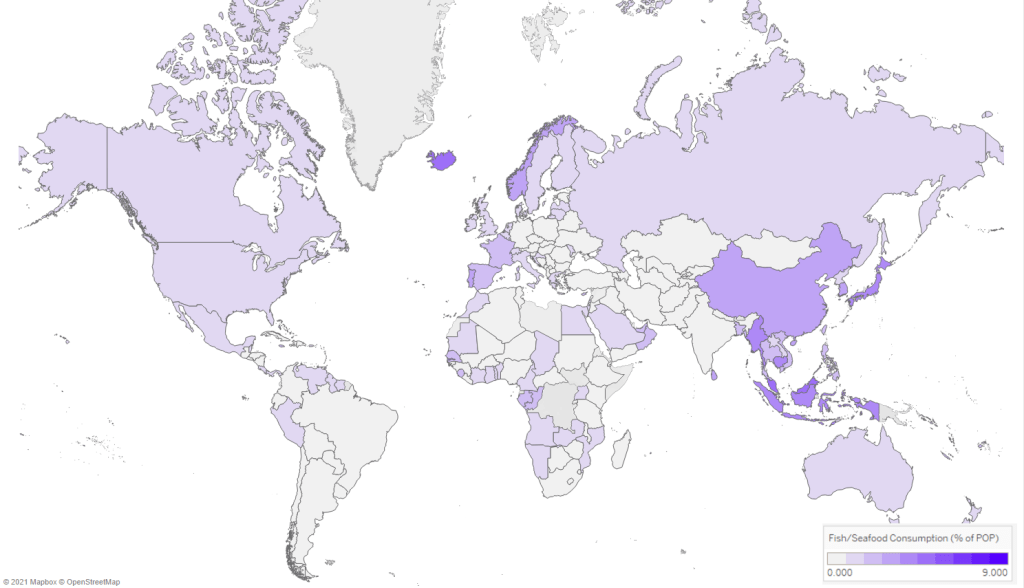
We can see that the bulk of the Asian/Pacific Island countries as well as Iceland, Norway, and Portugal are leaders in this field with a range of between 2-6% of each country’s total diet consisting of fish/seafood (meaning fish mixed with other food items). While this is a small number, we must consider the population count as well. Some countries may be negligible.
To give you an idea, we can chart out country populations filtered by their consumption of fish/seafood. We can then compare this to global fishery production.

While Iceland and Norway have a high diet of fish, they don’t make the list due to their small populations compared to the countries in the chart above. 1% of 100 (1) is a lot less than 1% of 1000 (10). We can assume from this that those countries ranked as having the highest consumption rates of fish/seafood and population would be the same as those which are producing the most fish (through commercial fishing). While this assumption is somewhat true, the next chart might make one consider otherwise.

In 2018, China, Indonesia, and India produced ~ 87.8 million metric tonnes of fish or 193.5 million kips (x1000 lbs). Taking each country’s individual fish production and dividing it by their total population (with conversions of course), estimates for China, Indonesia, and India include 45kg, 47kg, and 8kg (100lbs, 103lbs, 17lbs) of fish/seafood consumed per capita respectively. As big as the Indian population is, they don’t really eat as much fish compared to it’s neighboring countries. This suggests that India is a major contributor to fish exportation while China and Indonesia are massive consumers.
Looking at the rate of increase in commercial fishing, the charts below depicts growth in some of the top fisheries around the world across 2014 to 2017 (Latest Available Data).
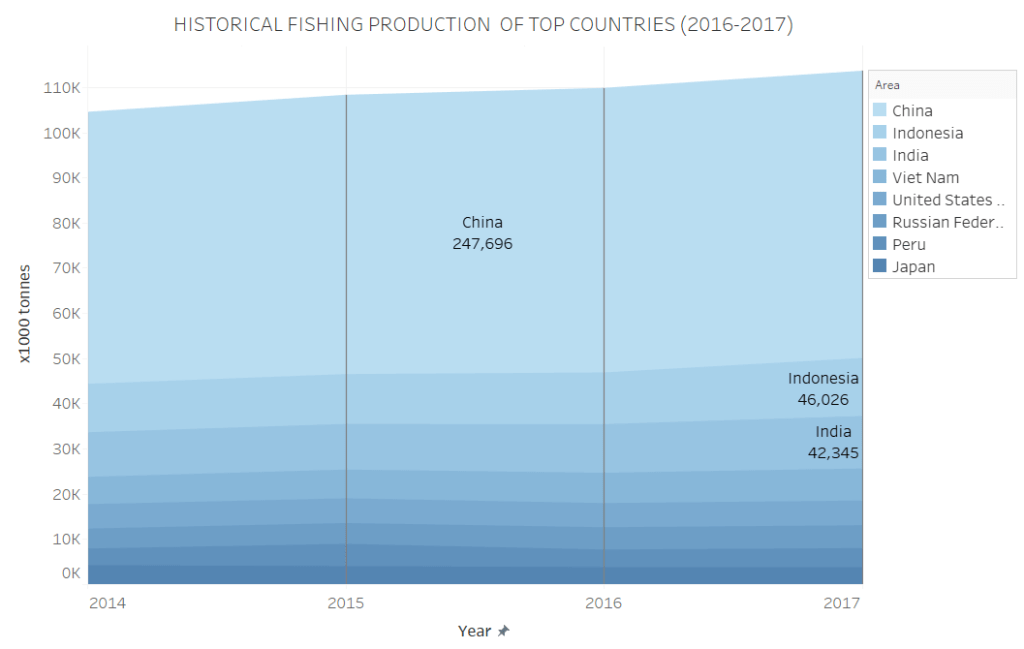
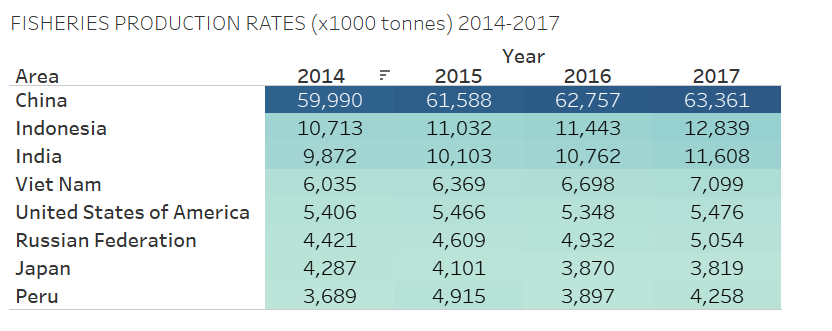
China, Indonesia, and India lead in fishery production with China being the largest producer by a factor of ~6x that of Indonesia and India and ~30x that of the United States. Between the rest of the countries, the rate of increase is nominal, possibly suggesting either stricter fishing regulations, less workforce, tougher economic issues or less supply within their established territories. Japan seemingly has decreased their production rate following 2015 but may have increased in later years. Unfortunately, I didn’t have the data for this.
We can calculate the percent change but it would be a bit misleading since Chinese production increased by 5.3% with Indonesian production increasing around 20% while the absolute change in production increased by 3371 and 2126 (x1000 tonnes) for China and Indonesia respectively between 2014 and 2017. These numbers are a bit comparable in the greater scheme of things but regardless, I have decided to include it.
On the Subject of Beef
One final thing I want to address is how cattle farming is one of the leading contributors to climate change. According to an article from UC Davis,
“Cattle are the No. 1 agricultural source of greenhouse gases worldwide. Each year, a single cow will belch about 220 pounds of methane. Methane from cattle is shorter lived than carbon dioxide but 28 times more potent in warming the atmosphere, said Mitloehner, a professor and air quality specialist in the Department of Animal Science.
With the escalating effects of climate change, that fact has advocates urging the public to eat less beef. They contend it’s an unsustainable diet in a world with a population expected to reach nearly 10 billion by 2050.”
It is important to note, however, that in the same way sharks eat their prey, human consumption of beef would also correlate to less greenhouse gas production although there would be a fine balance between how long cattle is raised before slaughter vs the rate at which they are consumed. Basically, this states that countries which possess major cattle populations with no crowd control would contribute more to global warming. If country X and Y both have a population of 100 cows, but X would slaughter 1 per year while Y slaughters 1 per month, X would contribute more towards greenhouse gas emissions.

The US leads the world in beef consumption by more than double Chinese consumption. This does not correlate with cattle production or livestock population as meat is something that can be imported. However, where there is demand, a supply will try to be met. If the US can begin to decrease its demand for beef products, we can potentially decrease the supply of cattle, thus resulting in a decrease of our contribution towards greenhouse gas emissions.
While I want this post to be focused more on fisheries, I felt it was important to point out another factor that effects our climate today. I don’t think the first thing people think of when it comes to combatting global warming is food consumption but it apparently plays a big role. Further analysis could include comparing the historical rate of cattle consumption to population growth rate to see if we are consuming more per person than we have in the past. This can be done by plotting relevant data on a multi-line chart and identifying the variance and standard deviation to determine when and if this occurred. We can dive further by comparing this to obesity/disease rates to see if there is actually any correlation and ultimately give us a reason to consume less cattle products.
It would also be interesting to consider how much commercial fishing and cattle farming contribute to global warming compared to one another. I’m not sure how this would be measured but hypothetically, if cattle actually contribute to global warming at less of a rate than the effects of commercial fishing, with the addition that the US decreases it’s demand for beef products, we could potentially export these products to other countries which require commercial fishing to feed their populations. This would in turn allow those countries to have less of a reliance on the oceans ultimately allowing our seas to stabilize.
Conclusion
There are a lot of things that I did not mention here but the overarching message of “Seaspiracy” seems to be correct. We need to take better care of our oceans and begin to combat overfishing and further address environmental and climate concerns across the world. Perhaps focusing our resources on better sustainability through things like vertical farming (see Aerofarm.com) or transitioning into and producing more “plant-based meat” might provide for viable alternatives. Population growth will never stop and that demand for food will continue to grow in direct proportion. This could mean that food prices will begin to skyrocket and more people would go hungry. I think problems like this might actually happen a lot sooner than we expect which means our future as a species would be in jeopardy. It can’t always be about making a profit either. We need to become more ethical and consider what effects our actions have. Hopefully, we can turn things around before it’s too late.
 Deep Patel
A good post on global fisheries. Thank you 😊
LikeLiked by 1 person