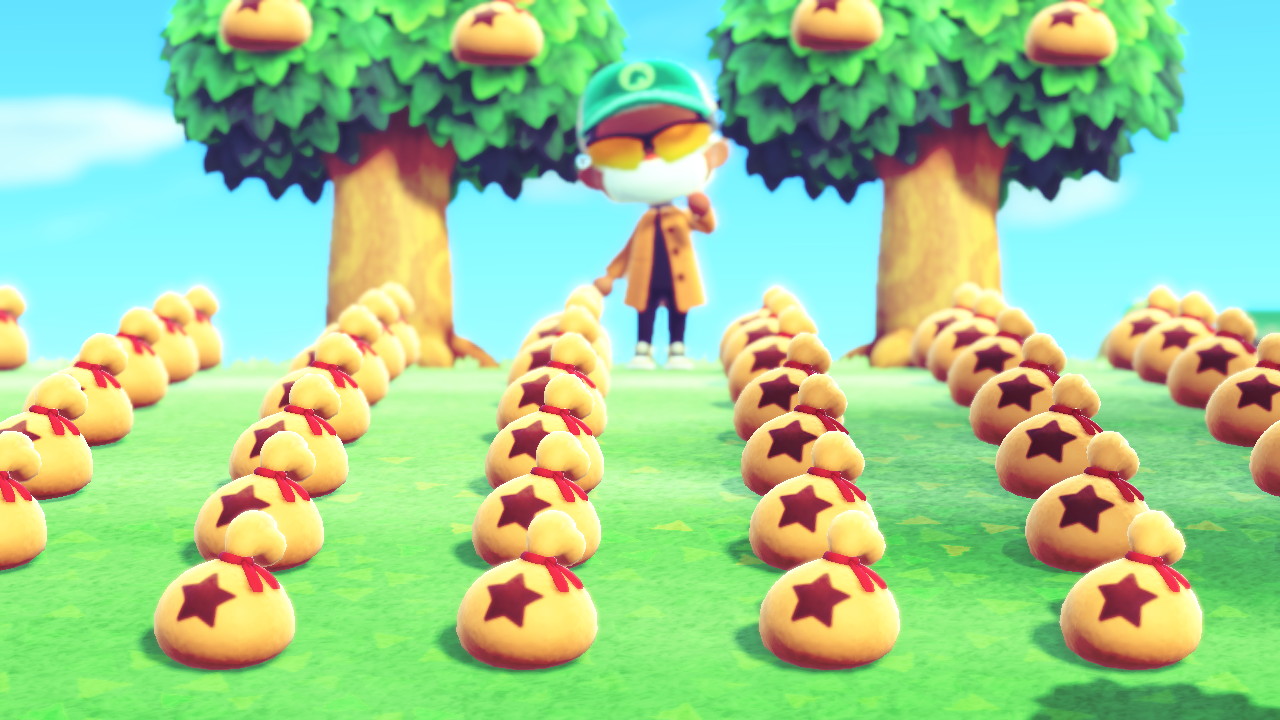
Animal Crossing has been taking the world by storm as possibly, the most played video game during the COVID-19 Crisis. With all the free time people have, came the release of an online peer to peer trading platform for in game items. Its massive player base and recent popularity made it a good opportunity to explore different aspects about a growing virtual marketplace guided by self-determined merchandise values
The experiment began when I decided to see how fast I could make money and grow my wealth. Imagine myself, as a humble, measly young farmer living on the side of an island. I have no wife or kids. I live in a 1 room house. I didn’t have a bed but a counter top. I needed a better life. A voice haunted over me, repeating, the loans! The loans!
Nookazon is quite literally the combination of Amazon/Ebay for Animal Crossing New Horizon. Prices are set by players as items can be traded through means of offerings, auctions, or by listing a price of your own choosing. It allowed for that something that would sell for 1000 in game could potentially be traded for 100,000 in the online market. The beauty of this is that… there aren’t any actual established prices for items in game. Although none of the money is actually real, it does seem to follow the same rules and applications that can be observed in modern day trades. Its interesting to see how players will make offers and counter offers based on each individual’s own emotional value for the product.
Exploiting different aspects of the game, a player can have a product which he can create, given the proper materials, or purchase for a set price in game. This same product can be listed online and sold for an extreme profit, or as I like to call it, “breaking the game” This is a when you have the resources available before you even begin to play the game as it was meant to be played. In Animal Crossing, I am paying off my loans as soon as I get them and spending freely without concern of price.
What needs to be explained for proper clarification is that the intention of the game was to have you live day by day and grow your island. This requires certain things to be done for each player to gain further resources. A few of these “financial constraints” are considered from the fact that Animal Crossing has two different types of currencies. Both of their individual values are undetermined and neither values higher or lower than the other but is only to be determined individually based on each player’s quantity or personal necessity. Bells are the in game currency similar to dollars while miles are gathered from completing a number of different activities around your island. What’s special about miles is that, it is the only currency you could buy nook miles tickets with. Just to give you an idea, 2000 Nook Miles equals 1 Nook Miles Ticket. These tickets are important as they allow the player to visit ghost islands in which they can gather the resources needed without any negative implications to their own. These two items, the Nook Mile Tickets and Bells should be considered as the two highest valued items or (tradables) in game.
For the sake of example, and something I have personally done, a player can buy DIY cards through their Nook Redemption for 1000 miles each. Listing the cards online, I have received offers that have allowed me to turn 3000 miles worth of DIY cards (the in-game value if sold to Nook’s Cranny) into 14,000 miles worth of tickets, (traded for on Nookazon and each of which are worth 1000 miles themselves). That’s a 7000 mile profit.
For this reason, it was very easy to exploit the marketplace and create a fortune in a matter of a few days. A lot of work went into understanding and setting up trades. I was running numbers and observing the market at the same time. The market itself was based on in real time. Since the game is played globally, the Asian market would differ from the American and European markets. The only hard part is finding products which will sell.
Eventually I managed to churn out a lot of bells by up selling on trades and I paid off all my loans and now have a 3 room house. I would buy items and gather them to large quantities before I sold for a profit to the highest bidder in a bulk deal. Products bought were determined by basic factors like base materials for building or the concept of how a DIY Card could serve more people than just the recipe itself. I was clever enough to pay attention to certain specific trends. My final trade was where I managed to turn 6 million bells into 40 million which I happily shared with my friends.
I believe there is much more to this game, that might have yet to be understood. Perhaps a lesson about how money moves through its environment. It was interesting to observe the dynamics of a market in chaos, and still beat it. Chaos but in a controlled and mannered form. All trades were based on trust. There was nothing that would’ve stopped someone had they wanted to rob you. Maybe it was easy because there was nothing to fear. It’s only a game. Not real money. Or maybe it can be inferred that money shouldn’t be limited to our only form of payment. That being said, the rules of supply and demand and interesting enough and the fact that they are certainly liable to emotional based transactions is the reason why prices will never be certain. It’s the life giving spark in every stock trade that occurs and every options put. The task of nurturing money and having the garden grow
The one perhaps, most important observations was the Value of Time.
For argument’s sake, let us consider time as the ultimate form of payment. Time is the only factor that everyone on Earth experiences equally. Its fair and just. There are always 24 hours in everyone’s day. It’s fair, just and everyone’s time is more of less the same (given everyone lives to the same age). This form of currency can stem into possibly 4 singular branches, each with their own result in the form of “payment”.
One branch being the expenditure of time in the form of leisure. Doing absolutely nothing for 1 hour is a waste of time. Whether this is good or bad is based on the individual’s discretion. Another branch is perhaps, spending time in a hobby or involving oneself in some type of enjoyment which results in a form of emotional relief. Branch 3, time spent in the form of work has the result of money. And perhaps the greatest expenditure of time, the 4th branch, might be giving your time for others. This results in something maybe more cosmic. Something that lives on beyond death.
In conclusion, applying these concepts in real life won’t be as easy as in a video game. Nookazon however, might be the seeds of a new internet platform if it grows in the same rate as Animal Crossing’s player base. If the game continues to grow and the designers willing to do their part, it might actually serve as a good teaching instrument on the creation and understanding of wealth or even encourage more internet platforms for eCommerce.
To Be Continued…
UPDATE 8/4/2020 : I have experimented with creating a business to test this and found great success through E-Commerce markets such as Ebay and Amazon netting a profit of $2000 and growing. I will share my experience in a future post
 Deep Patel